DishBrain Playground
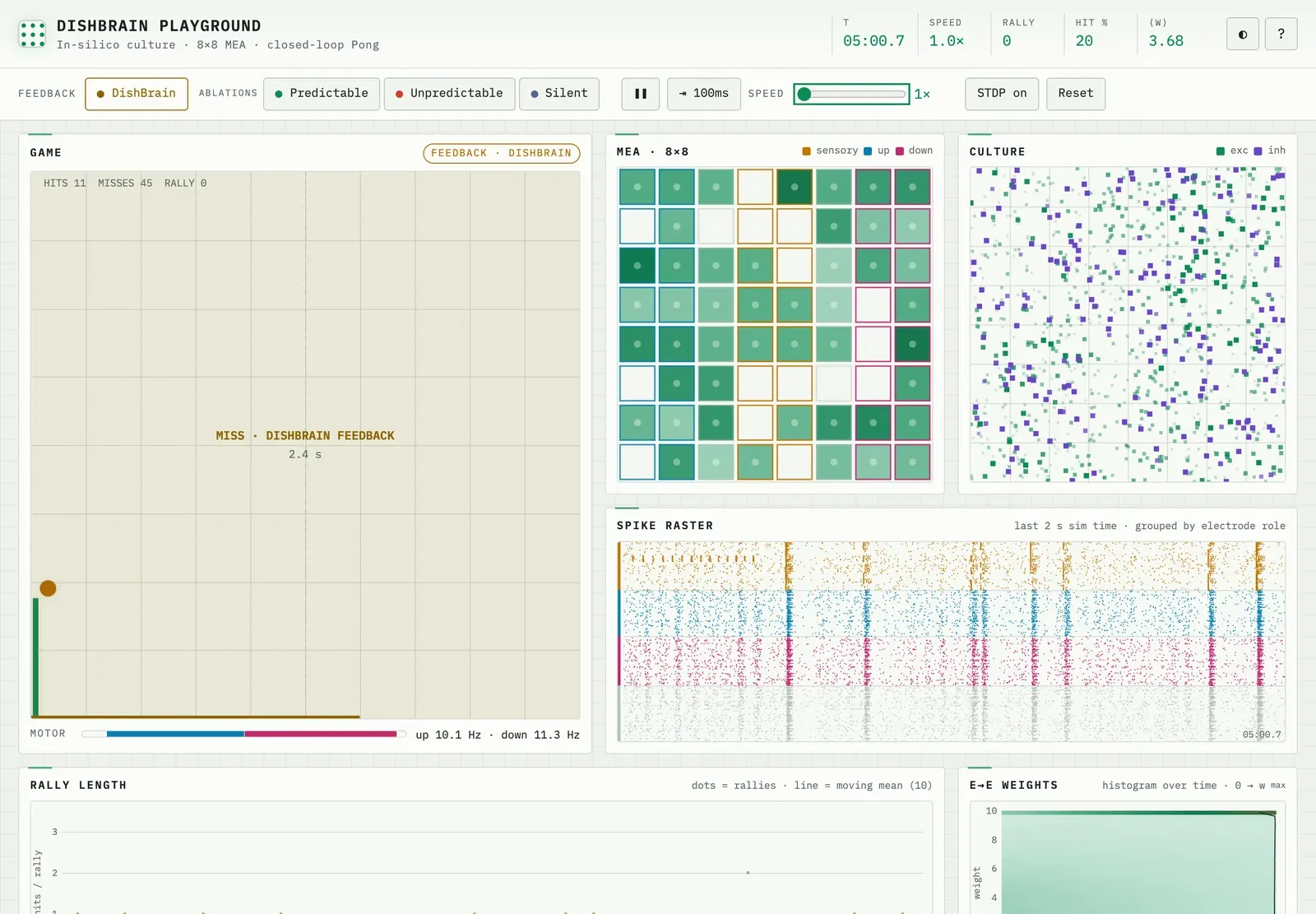
A thousand simulated spiking neurons on a virtual electrode array play Pong in the browser. The paper’s feedback teaches them nothing; feedback the network can switch off itself does.
- Role
- Solo
- Stack
Problem
In 2022 Kagan et al. connected cultured neurons to Pong and reported that cultures given predictable feedback after hits and unpredictable noise after misses rallied longer over time. I wanted to know whether plain spike-timing-dependent plasticity in a generic spiking network is enough to produce that.
What I built
1000 Izhikevich neurons (80% excitatory) with STDP, sitting under an 8×8 virtual electrode array with sensory and motor regions, place and rate coding for the ball, and a population-rate decoder for the paddle.
The paper’s feedback protocol (a predictable burst after a hit, 4 s of random stimulation after a miss) plus three ablations that change only what follows a miss: predictable, unpredictable and silent.
Two candidate mechanisms as extra modes: stimulation avoidance (stimulation that stops within 1 ms once the paddle steers toward the ball) and reward-modulated STDP with eligibility traces, each with a matched control.
A browser playground with a live raster, electrode map and rally curves with 95% confidence bands, plus a headless npm run experiment that runs paired seeds and Mann-Whitney U tests.
Results
- Paper protocol, 12 paired seeds, 20 simulated minutes each: no learning. Rally length stayed near 0.3 hits per rally, the same as with plasticity off (DishBrain vs silent, p = 0.30). STDP links spikes about 20 ms apart, and the feedback arrives seconds later regardless of what the network did.
- Stimulation avoidance, on held-out seeds after tuning only on separate dev seeds: the correct sensory-to-motor wiring formed (mapping index 0.75 vs 0.01 with STDP off, p < 0.001) and late rallies beat the STDP-off control on 10 of 12 seeds (p = 0.002). The gain is real but modest: median late rally 0.56 vs about 0.35.
- Reward-modulated STDP did not beat its shuffled-reward control (p = 0.53). Each reward nudges about 64,000 synapses and a session has only about 230 rewards. I report both nulls as they came out.