Organoid Reservoir
Brainoware-style reservoir computing on a simulated organoid, benchmarked against an echo state network and an LSTM.
- Role
- Solo
- Stack
Problem
In 2023 Cai et al. used a human brain organoid as the reservoir in a reservoir computer and reported vowel recognition and chaotic time-series prediction. I wanted to see how much of that a simulated organoid-like network reproduces, and how it compares with standard reservoirs when the encoding, readout and data splits are held fixed.
What I built
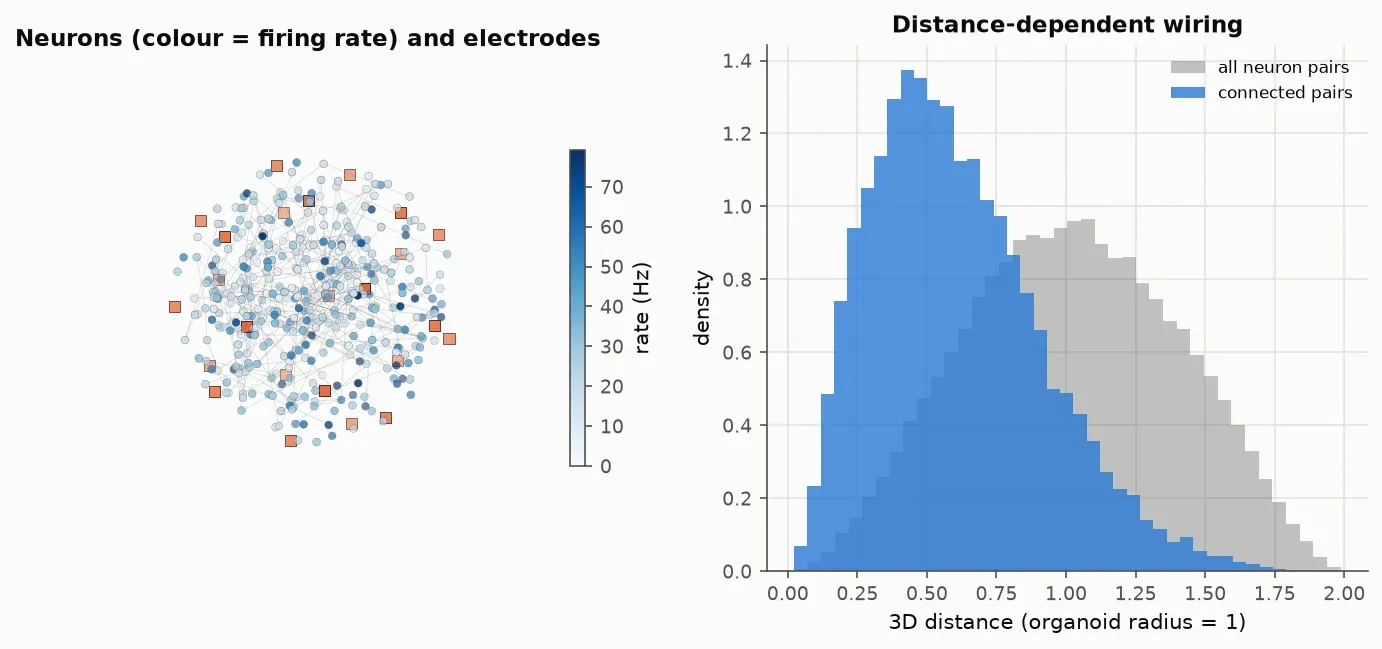
400 Izhikevich neurons wired inside a sphere with distance-dependent connections, background noise, optional NMDA-like synapses and STDP.
A virtual electrode array on the surface that encodes inputs as pulse trains or DC current; only a linear readout is trained.
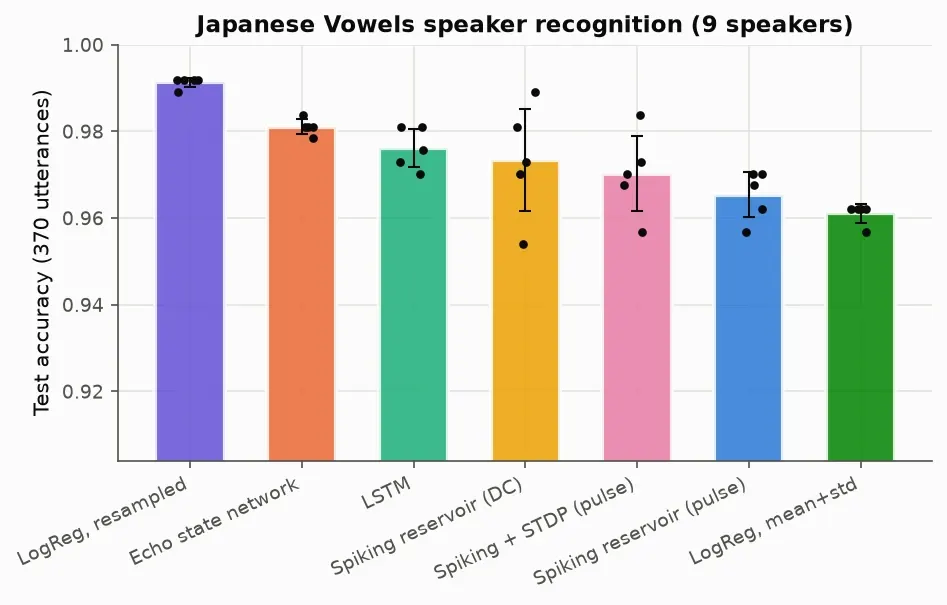
Tasks: Japanese Vowels speaker recognition, Hénon, NARMA-10, Mackey-Glass and memory capacity. Baselines: ESN, LSTM, logistic regression and linear autoregression. Ablations on STDP, size, stimulation type and noise.
Results
- Vowels: 0.965 accuracy for the spiking reservoir vs 0.981 for the ESN and 0.991 for logistic regression on resampled features (5 seeds).
- Memory capacity is about 0.6 vs 10.1 for the ESN, so it does poorly on time series that need history. STDP moves vowels accuracy by about half a point, inside seed noise.
make reproduceregenerates every number and figure in about 13 minutes on a laptop CPU.