Wetware Emulator
A simulated cortical culture on a virtual multi-electrode array, with an SDK, HTTP API and live dashboard for prototyping biocompute experiments without a wet lab.
- Role
- Solo
- Stack
Problem
Living neurons on electrode arrays can now be reached over the internet, but access is scarce and slow, and I don’t have a wet lab. I wanted somewhere to write and debug a whole experiment first (stimulation protocol, closed loop, analysis, file handling) against something that fails the way a real culture does.
What I built
A NumPy simulation core: Izhikevich neurons placed in 2D, distance-dependent wiring, short-term plasticity, STDP and spontaneous bursts.
A virtual MEA that turns spikes into extracellular signals with noise, stimulation artifacts and blanking, plus biphasic stimulation that raises on unsafe waveforms instead of clipping them.
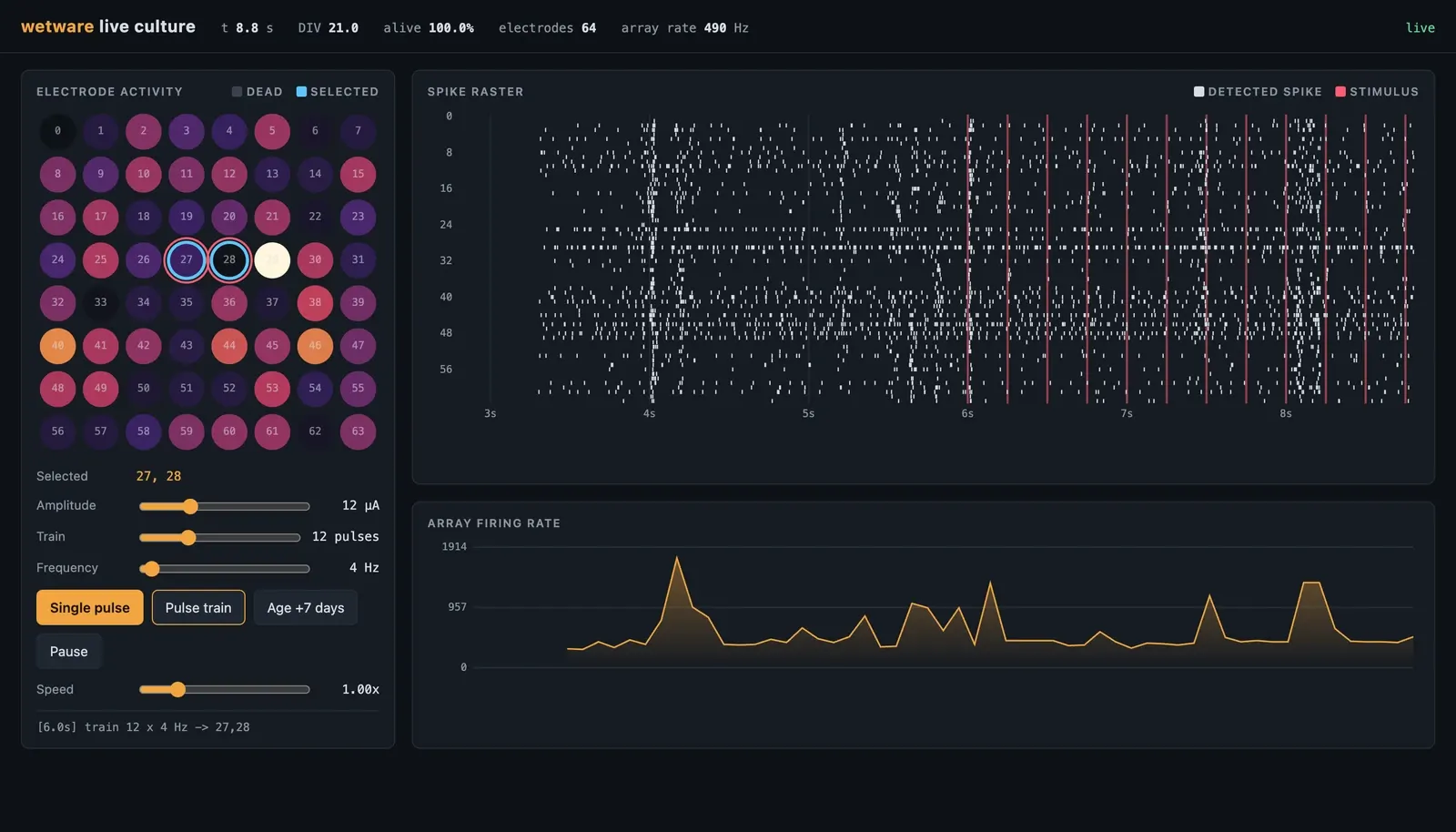
Closed loops on the simulation clock, culture aging (neurons and electrodes die), HDF5 export, YAML protocols, an HTTP server with a matching client, and a live browser dashboard.
Results
- A 1000-neuron culture runs about 15× faster than real time on one laptop core.
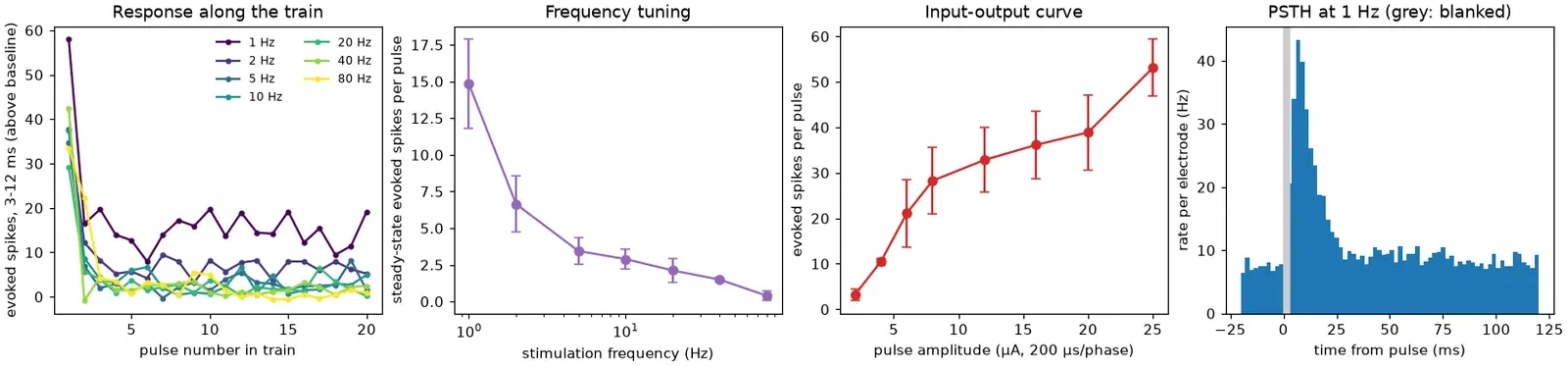
- Frequency tuning: the evoked response falls from 14.8 spikes per pulse at 1 Hz to 2.9 at 10 Hz and 0.4 at 80 Hz, from synaptic depression.
- Closed-loop Pong, 6 cultures per condition: no learning (0.57 hits per rally with feedback, 0.48 without). I kept it as an example of wiring a closed loop, not as evidence the model learns.